






Unique marine energy device successfully tested in University's Wave Tank
A potentially revolutionary device developed in the region for generating marine renewable energy has been successfully tested in Plymouth University's Wave Tank.
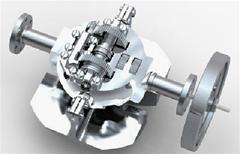
The WITT transmission system is unique and capable of collecting chaotic movement in any direction to turn it into useable power.
The system has numerous potential applications in the marine environment - sea, river or tidal - from lighting navigational buoys to GPS systems and the charging boats when moored.
It can also be used on land in a backpack, utilising all motional energy from walking or jogging and converting it into energy that can be used to illuminate pedestrians or animals in the dark. It could also be used for GPS tracking systems for endangered species and hundreds of the devices could be assembled on a stretch of water to produce an inexpensive and spectacular effect.
The WITT (Whatever Input to Torsion Transfer) is capable of using all six degrees of motion, clockwise, anti-clockwise, up and down and back and forth at any speed to turn a flywheel to create electricity.
Invented by civil engineer Martin Wickett in his workshop in 2008, the prototype was constructed from off-the-shelf components; the basic principle is capable of being scaled up or down from devices the size of a golf ball to those several metres wide.
Witt Limited became the first commercial customer to use Plymouth University's Wave Tank to test the device in a number of simulated conditions, including a river flow. It will be tested in a fast-moving tide at a later date.
The WITT, which is enclosed in a sealed sphere, proved a success and more trials are scheduled to take place in Wave Tank in January 2013 and later in Plymouth Sound.
Three to four watts were generated from the one kilo device and indications are that double the power can be generated when the weight of the device is doubled. The next pre production WITT will be able to have up to 25 kilos in weight as an energy collecting transmission system, all parts are industry standard components, ensuring the WITT is 'fit and forget' a truly green solution in the marine environment
WITT Managing director Mairi Wickett said: "The Marine Institute and the Wave Tank is a real asset, not only the physical equipment but the support given by the University's Marine commercial Director Adam Corney."
Staff made connections for WITT with regional advisory services and facilitated a collaboration with Paul Fairhurst, the Managing Director of moulding engineers Orchid Plastics of Kelly Bray, near Callington, Cornwall. Orchid Plastics will manufacture a large marine buoy so the device can be tested in Plymouth Sound.
Mairi said WITT are looking forward to working with Orchid Plastics in a collaboration and getting WITT's out to a global market.
The Witt Company is confident there is huge potential for the device. The marine environment has many uses for this technology, charging batteries on boats (even when moored up) aqua-culture, oceanography, and novelty and safety lighting.
Mairi added: "Thomas Edison once famously said that genius is one per cent inspiration and 99 per cent perspiration and this is very much how we found the going in the early stages.
"We knew the technology worked and that it would have applications in many different environments, but we needed help to get in front of the right people.
"As the Witt is a completely enclosed device and none of the parts are exposed to the elements, it can be used in even the harshest of environments, the WITT sealed unit will collect energy from sea, river and tidal locations, so it is perfect for aquaculture and oceanography and industries like navigational lighting who have major maintenance costs sending out boats in harsh conditions to clean solar panels and to change batteries at a cost of between £15,000 to £20,000 per day.
"It is maintenance free, a major cost and logistical issue for marine applications, and in addition creates no environmental impact."
The company which has offices in Bude, north Cornwall and Ermington, near Plymouth, Devon, believes that in addition to the marine sector, this new technology has applications in a wide variety of industries.
It has successfully applied for patents and plans to licence the Witt to large multinational technology companies and see applications for the product in everything from consumer electronics to tidal power systems.
"Witt Energy Solutions has a fantastic product and can be a truly global company - while creating and sustaining jobs here in the South West," said Martin, inventor of the WITT and Technical Director.
Witt believes it is advancing the renewable energy market for both industrial and consumer markets. Solar energy is expensive and does not work 24 hours a day, wind energy is directionally dependent and unable to cope in excessive conditions and existing wave energy devices have multiple issues.
The potential market for more energy efficient energy conversion device is large and continues to grow. In 2009 wind energy received US$63 billion of investment to install 38 GW of capacity worldwide. The European Union has targets to achieve 50% of its electricity from renewable marine energy by 2050.
Martin added: "The economic, social, and environmental impacts of this technology is massive. The 'WITT device has positive impacts for all these three key sustainability issues. The social benefits will also be positive as we see a scaled down version of the 'WITT' device being used by consumers to generate "clean power" in portable power applications and for domestic power generation. "
The WITT team is: Chairman, Russell Ward, BA, MIOD, MCIM; Technical Director, Martin Wickett, B.Sc Hons; Managing Director, Mairi B Wickett, BA Hons, Fine Art; Director Penny Paddle, LLB Hons; and Financial Director, Edwin Strang, CA, FIOD.
The company has a strong team in place with 18 investors (80% from the South West) and match funding through South West Investment Group (SWIG). Interest in the application has come from aqua-culture, navigational and LED lighting companies all seeking a marine power solution.
The Marine Institute is HQ of the Growth Acceleration and Investment Network (GAIN). GAIN adds value to existing regional assets, from science parks, innovation centres to academic research facilities and expertise, by joining them all up to create a focused and accessible business ecosystem of aspirational businesses and investors.
Pictures left to right: the WITT prototype; Managing Director Mairi Wickett and inventor Martin; the Wave Tank in the Marine Institute (credit Lloyd Russell)

