






Witt renewable energy device receives development funding
A potentially revolutionary device for generating marine renewable energy has been awarded a £190,000 development grant by the Technology Strategy Board (TSB).
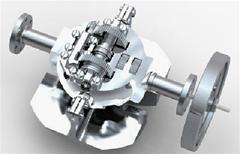
The Whatever Input to Torsion Transfer (WITT) transmission system is unique and capable of collecting chaotic movement in any direction to turn it into useable power.
The TSB award for Vessel Efficiency is the first of its kind and follows successful testing of the device in the Wave Tank at Plymouth University and in Plymouth Sound.
The £300,000 project, Energy Harvesting Technology from Vessel Motion, will be led by A&P Shipping, Falmouth, with Devon-based Supacat working on design and build working with Plymouth and Exeter Universities will also join WITT to advance a new patented technology.
As well as the TSB's grant A&P, Supacat and WITT will make 'in kind' contributions totalling £11,000 towards the cost of development.
The 10 month project will commence on 1st July 2013, with WITT and Supacat working on the technology, the aim is to capture 'pitch and roll' motion and turn it into power, which will reduce the amount of fuel the ship will use on normal day to day tasks.
The system has numerous potential applications in the marine environment - sea, river or tidal - from lighting navigational buoys to GPS systems and the charging of boats when moored.
The WITT system has many other applications, for example it can also be used on land in a backpack, utilising all motional energy from walking or jogging and converting it into energy that can be stored and used as and when needed, charging appliances etc, also to illuminate pedestrians or animals in the dark. It could also be used for GPS tracking systems for endangered species.
The WITT is capable of using all six degrees of motion, clockwise, anti-clockwise, up and down and back and forth at any speed to turn a flywheel to create electricity.
Invented by civil engineer Martin Wickett in his workshop in 2009, the first prototype was constructed from off-the-shelf components; the basic principle is capable of being scaled up or down from devices the size of a golf ball to those several metres wide.
Witt Energy Limited became the first commercial customer to use Plymouth University's Wave Tank to test the device in a number of simulated conditions, including a river flow.
The next pre production WITT will be able to have up to 25 kilos plus in weight as an energy collecting transmission system, all parts are industry standard components, ensuring the WITT is 'fit and forget' a truly green solution in the marine environment.
WITT Managing director Mairi Wickett said: "The Marine Institute and the Wave Tank is a real asset, not only the physical equipment but the support given by the University's Marine commercial Director Adam Corney."
The Witt Company is confident there is huge potential for the device. The marine environment has many uses for this technology, charging batteries on boats (even when moored up) aqua-culture, oceanography, data gathering buoys, novelty and safety lighting, collecting power for auto naught boats.
Mairi added: "We knew the technology worked and that it would have applications in many different environments, but we needed help to get in front of the right people.
"As the Witt is a completely enclosed device and none of the parts are exposed to the elements, it can be used in even the harshest of environments, the WITT sealed unit will collect energy from sea, river and tidal locations, so it is perfect for aquaculture and oceanography and industries like navigational lighting who have major maintenance costs sending out boats in harsh conditions to clean solar panels and to change batteries at a cost of between £15,000 to £20,000 per day.
"It is maintenance free, a major cost and logistical issue for marine applications, and in addition creates no environmental impact."
WITT has tested the WITT device on Plymouth Marine Laboratory boat. The next step is to fit a WITT system on PML's data gathering buoy for a trial period.
At present PML is using Solar panels and a small wind turbine, the WITT offers many USP's in that it will work 24/7 collecting all pitch and roll motion and turning it into useable power, this will reduce the maintenance costs, and also offer the opportunity of connecting other data gathering systems with no worry about the power requirements.
WITT Energy has offices in Bude, north Cornwall and Ermington, near Plymouth, Devon, believes that in addition to the marine sector, this new technology has applications in a wide variety of industries.
It has successfully applied for patents and plans to licence the Witt to large multinational technology companies and see applications for the product in everything from consumer electronics to tidal power systems.
The WITT team is: Technical Director, Martin Wickett, B.Sc Hons; Managing Director, Mairi B Wickett, BA Hons, Fine Art; Director Penny Paddle, LLB Hons; and Financial Director, Edwin Strang, CA, FIOD.

